

Can Minors Sell on Etsy? Rules, Fees, and Better Options for Younger Founders
Your child makes clay charms, friendship bracelets, or digital art. A relative says, “Put it on Etsy.” It sounds simple because the buyers are already there.
The age rule changes the plan.
For an eligible teen with a strong handmade product, Etsy can be useful. For a younger child, or for a family that wants the child to have a true founder account, it is not the right structure.
Etsy’s rules for sellers under 18
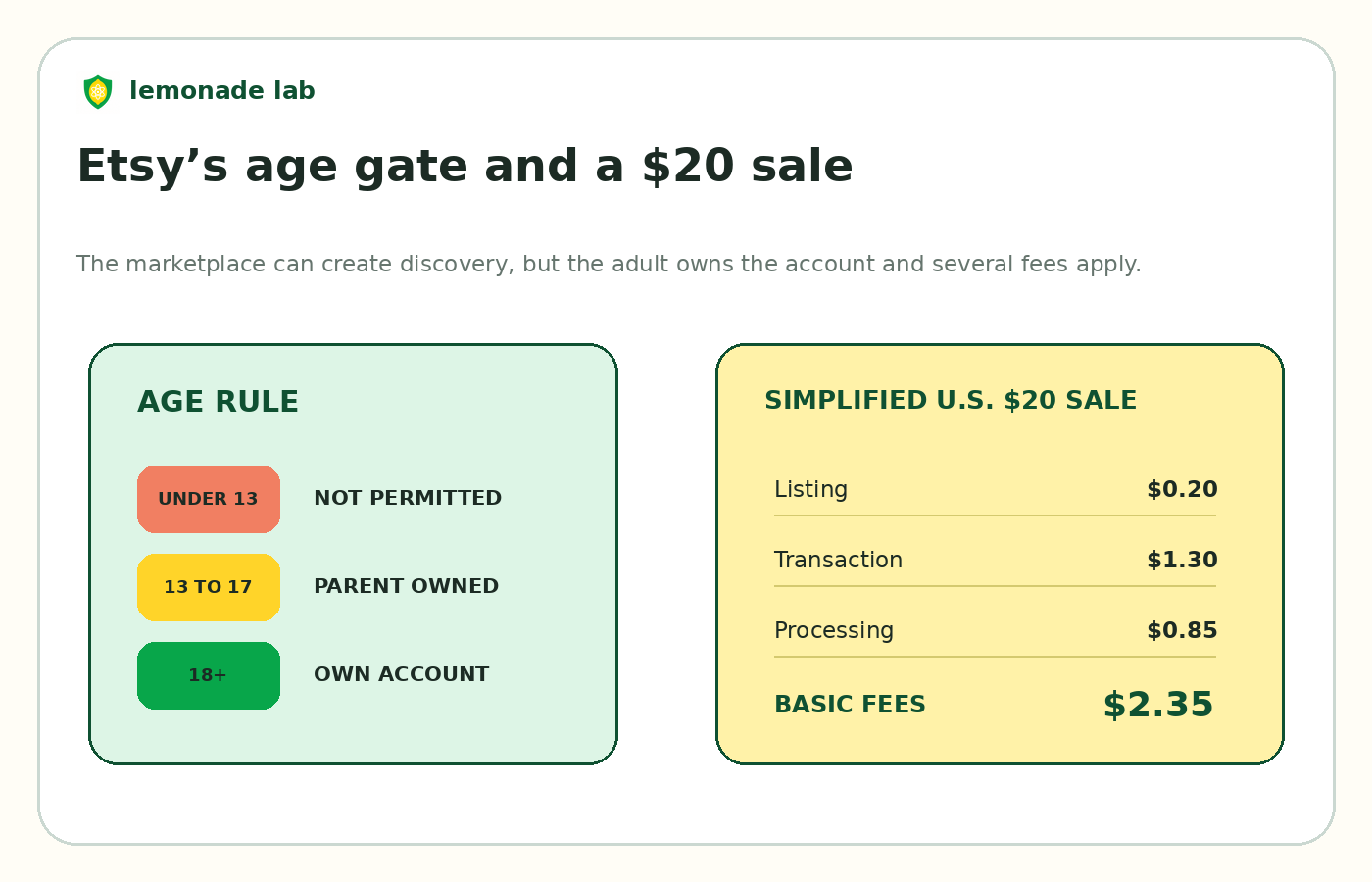
Etsy’s minors policy is unusually specific. A seller aged 13 to 17 may use the service only through an account owned by a parent or legal guardian. The parent must supervise the activity directly.
The policy requires:
- The parent or guardian’s name on the account
- The parent or guardian’s financial information
- The parent or guardian’s email address
- The adult to be listed as the shop owner
- All people involved in the shop to be listed in the shop’s About section
- Ongoing direct supervision of the minor’s activity
A child under 13 cannot operate an Etsy account, even through a parent. Etsy says accounts used in violation of its minors policy may be permanently closed.
Do not solve the age issue by entering a false birthday or putting the child’s name into adult verification fields. That creates a fragile business. A policy check, payment verification, or customer dispute can expose the mismatch after the family has invested time and built reviews.
The ownership issue parents often miss
A supervised Etsy shop may feel like the teen’s business at home. On Etsy, the adult owns the account.
That matters later because Etsy does not permit account transfers. If the teen turns 18 and wants an account in their own legal name, Etsy’s current guidance says a new owner must open a new account and shop. The existing account, shop history, and reviews are not simply reassigned.
For a small experiment, that may not matter. For a teen who builds hundreds of sales and valuable reviews, it can become a real transition problem.
Before opening the shop, decide if you are comfortable building marketplace history under the parent’s identity.
What it costs to sell on Etsy
Etsy does not charge a standard monthly shop subscription, but several fees can apply. The main ones are:
- A one time shop setup fee may apply, with the amount shown during onboarding
- A US$0.20 listing fee for each listing
- Listings expire after four months unless renewed
- A 6.5% transaction fee on the order amount, including shipping and gift wrap where applicable
- Etsy Payments processing fees that vary by country
- Possible advertising fees, currency conversion fees, regulatory fees, and other charges
In the United States, Etsy Payments is currently 3% plus US$0.25 per order. In Canada, domestic and U.S. orders are currently 3% plus C$0.25.
For a simplified US$20 sale with no shipping charge, tax, or advertising fee:
- Listing fee: US$0.20
- Etsy transaction fee: US$1.30
- Payment processing: US$0.85
- Total basic fees: about US$2.35
- Amount left before materials, packaging, and tax: about US$17.65
That is an effective basic fee of 11.75% on a US$20 item. Small order values make fixed fees more noticeable.
Why Etsy can still be worth it
Etsy has something Shopify, Square, and a new independent shop do not automatically provide: people already visit Etsy looking for handmade, designed, vintage, and craft related products.
That built in shopping intent is valuable. A teen with a polished product can learn:
- How search titles and photos affect clicks
- How customers compare similar products
- How reviews influence trust
- How to package and ship consistently
- How fees change the real profit on an item
- How to respond to questions and solve problems
Choose Etsy when:
- The seller is 13 to 17
- The product fits Etsy’s marketplace rules
- A parent will directly supervise the account
- Marketplace discovery is more important than owning the customer experience
- The family understands the fee structure
- The product margin can absorb listing, transaction, and processing fees
- The parent accepts that the shop history remains tied to the parent owned account
A 16 year old selling carefully photographed crochet patterns may have a good reason to use Etsy. The marketplace is aligned with the product and can expose the teen to customers outside the family’s network.
Where Etsy is a poor fit
Etsy is not designed for every kind of child business.
It is a weak fit when:
- The child is under 13
- The business sells local services such as lawn care, tutoring, pet care, or face painting
- The child wants a personal founder profile rather than an adult owned marketplace account
- The parent cannot supervise messages, orders, fulfillment, and refunds
- The item price is low and margins are thin
- The child changes ideas often
- The family wants to preserve a portable business identity as the child grows
There is also a motivational difference. Etsy puts the product into a large adult marketplace. The child competes beside experienced sellers with professional photography, optimized listings, fast shipping, and thousands of reviews. That can be educational, but it can also make a first attempt feel invisible.
Etsy versus Lemonade Lab
Lemonade Lab is not an adult craft marketplace. It is a business building platform for kids and teens. The child creates the shop and founder identity while a connected parent supervises and approves key money actions where required.
| Decision factor | Etsy | Lemonade Lab |
|---|---|---|
| Minimum age | 13 with parent permission and direct supervision | Kids may create; some public, sales, communication, and funds features require parent approval, especially under 13 |
| Account owner | Parent or guardian | Child facing account with parent connection and oversight |
| Main advantage | Existing marketplace of shoppers | Complete first business experience built around the child |
| Product fit | Handmade, designed, vintage, and craft supplies under Etsy rules | Products and many local or online services |
| Fees | Listing, transaction, processing, and possible additional fees | Free to start; first $100 earned monthly has no transaction fee, then 3.5% shop running cost; cashout costs may apply |
| Discovery | Stronger marketplace search potential | Growing community discovery, plus direct sharing by the founder and family |
| Child progression | Standard seller tools | Quests, levels, status, collaboration, and founder identity |
| Transition at 18 | Account transfer is not permitted | Founder identity is designed to persist as the child grows within the platform |
Etsy is stronger when a teen needs access to a large craft marketplace. Lemonade Lab is stronger when the first goal is to help a child create, test, sell, and build confidence inside an environment designed for young founders.
It is possible to use both later. A teen can validate products and develop the business inside Lemonade Lab, then add Etsy when marketplace demand becomes useful. That sequence avoids paying marketplace fees before the product and fulfillment routine are ready.
How to decide whether Etsy traffic is worth the fees
Marketplace traffic is not guaranteed traffic. Opening an Etsy shop does not mean the first listing will be discovered.
Use this test:
- Search Etsy for the exact product.
- Note the price range, photo quality, review counts, shipping promises, and personalization options on the first page.
- Calculate the full cost of materials, packaging, postage, Etsy fees, and the teen’s time.
- Ask whether the product has a clear reason to be chosen over established alternatives.
- Decide how many sales are needed before the setup effort becomes worthwhile.
A product can be lovely and still be a poor marketplace product. The purpose of the test is not to discourage the child. It is to show that a business decision is different from a compliment.
A parent supervision plan that does not take over
Direct supervision does not require the parent to rewrite every listing and answer every customer.
A useful division is:
The teen drafts:
- Product titles and descriptions
- Photos and packaging ideas
- Price and profit calculation
- Customer response drafts
- Production and shipping schedule
The parent reviews or controls:
- Account verification and financial information
- Public personal details
- Messages involving custom requests or personal information
- Refunds, disputes, and difficult customers
- Shipping commitments
- Taxes and record keeping
- Any advertising spend
The teen should see the actual fees and calculate profit on every product. Otherwise the marketplace teaches sales volume without teaching business economics.
Frequently asked questions
Can a 12 year old sell on Etsy with a parent?
No. Etsy’s policy says children under 13 are not allowed to use the service. A parent can run their own Etsy business and sell products they produce with family involvement, but the under 13 child cannot operate as an Etsy user.
Can a 15 year old have an Etsy shop?
A 15 year old may participate only with a parent or legal guardian’s permission and direct supervision. The adult owns and registers the account and provides the financial information.
Can the shop be transferred to the teen at 18?
Etsy does not permit account transfers. Its guidance says the new owner needs a new account and shop. Families building a meaningful shop should plan for that before investing heavily in reviews and brand history.
Does Etsy take a percentage of shipping?
Etsy’s 6.5% transaction fee applies to the displayed listing price plus shipping and gift wrapping charged to the buyer. Payment processing is calculated separately under the applicable country rate.
What can a younger child use instead?
A younger child can create a parent supervised shop through Lemonade Lab. Some features require parent approval, particularly for children under 13. The parent remains responsible for supervision, fulfillment, refunds, taxes, and local rules.
The decision
Etsy can be a good sales channel for a supervised teen with the right product. It is not a child owned account, it is not available to children under 13, and its fee and ownership structure should be understood before the first listing goes live.
Use Etsy for marketplace reach. Use Lemonade Lab for the child’s first founder experience. Add the marketplace when the business has earned the complexity.
Platform rules and prices were checked on August 17, 2026. Fees and policies can change. This article is general information, not legal, tax, or accounting advice.