

Best Online Store Platform for Kids: Shopify, Square, Etsy, or Lemonade Lab?
A parent can now assemble a child’s business from adult tools: one website builder, one payment processor, a marketplace account, a spreadsheet, and several passwords. It works. It also creates a small company the parent has to operate.
The better question is not “Which platform has the most features?” It is “What does this child need to do next, and who should be doing it?”
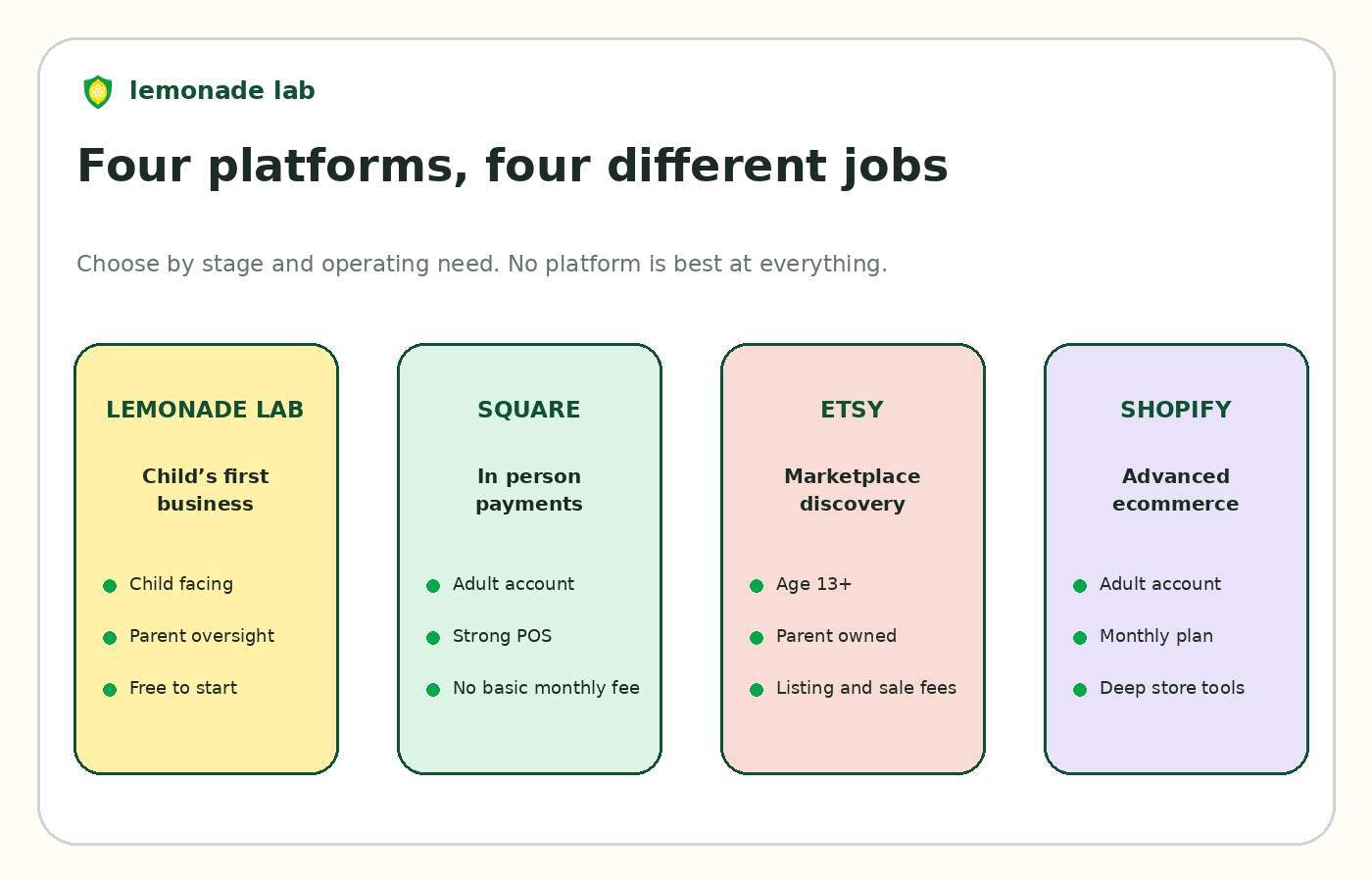
No platform wins every category. The right choice changes as the business grows.
The four platforms in one table
| Platform | Best use | Who owns the account? | Starting cost | Main limitation for a child |
|---|---|---|---|---|
| Lemonade Lab | A child’s first real shop or service business | Child facing account with parent connection and approvals | Free to start | Less advanced than a mature Shopify or Square operation |
| Square | In person card payments, stands, markets, local services | Adult | No monthly fee on Square Free, payment fees on sales | Adult POS system, not a child founder environment |
| Etsy | Marketplace discovery for handmade or designed products | Parent or guardian for sellers aged 13 to 17 | Listing and sale fees; setup fee may apply | Under 13 prohibited; adult owns account and reviews |
| Shopify | Full ecommerce store with brand, inventory, shipping, apps, and scale | Adult | Monthly plan plus payment and possible app costs | Fixed cost and adult merchant complexity |
This is the central pattern: adult commerce platforms organize the experience around the merchant account. Lemonade Lab organizes it around the young founder and the supervising parent.
First, decide what “the child’s business” means
Families use the same phrase for very different arrangements.
A child inspired product inside a parent business
The parent chooses the platform, owns the brand, runs the website, takes the money, and handles customers. The child contributes ideas or designs.
Shopify, Square, or Etsy can all work because the parent is the operator.
A family business run together
The parent and child divide the work. The adult owns the account and legal responsibilities. The child handles products, sales, or content.
Any of the four platforms may work. The decision depends on sales channel and complexity.
A child led first business
The child chooses the idea, creates the shop, sets proposed prices, interacts with the work, tracks progress, and develops an identity as the founder. The parent supervises safety, payments, promises, and legal obligations.
Lemonade Lab is designed for this model. The adult platforms can be adapted to it, but they do not make it the default.
The distinction matters because a parent can create a technically excellent shop that teaches the child almost nothing.
Lemonade Lab: best for the child’s first operating system
Lemonade Lab lets kids and teens turn an idea into a real shop, add products or services, take orders and payments, complete founder quests, collaborate, and build status and progression. Parents connect through a dedicated dashboard, see activity, and approve money movement where required.
What it does well
- Child facing shop and business creation
- Products and services rather than products only
- Real checkout and payment options
- Parent visibility and cashout approval
- Safety systems built around young users
- No fixed cost to test the first idea
- Quests, levels, collaboration, and founder identity
- A business can evolve as the child’s interests change
Current pricing is free to start with no credit card or time limit. The first $100 earned each month has no transaction fee. After that, a 3.5% shop running cost applies. Cashout processing costs may apply and are shown before the parent approves the cashout. Optional memberships add tools and may remove some cashout costs.
What it does not replace
Lemonade Lab is not as deep as Shopify for complex ecommerce. It does not have Etsy’s existing marketplace scale. It does not offer Square’s full adult retail POS stack.
Choose it because the child experience and parent oversight are core requirements, not because it has every feature an established adult business might need.
Best fit
- Kids and teens testing a first idea
- Local services such as pet care, tutoring, lawn care, or creative services
- Products sold to family, community, school, or an emerging audience
- Parents who want supervision without operating every screen
- Children motivated by progress, identity, and ownership
Square: best for a parent run payment counter
Square is a strong point of sale and payments platform. Its free plan has no monthly software charge, and it supports card readers, Tap to Pay on compatible phones, payment links, invoices, and online tools.
The account holder must be at least 18. A parent can open the account and supervise the child using it, but deposits, reporting, refunds, disputes, and customer records belong to the adult account.
What it does well
- Fast in person card acceptance
- No monthly fee on the basic U.S. and Canadian plans
- Clear transaction based pricing
- Useful hardware options
- Receipts, item catalog, reports, and sales tracking
- Room to grow into broader retail or service operations
What parents should watch
- The adult owns the merchant account
- Tax reporting may connect to the adult’s information
- The system is designed for adult business operators
- The child may see only the checkout screen rather than the whole business
- Hardware and advanced subscriptions can add cost
Best fit
- A one day market or lemonade stand
- A parent who already uses Square
- A child mainly selling face to face
- A family business where the adult manages the operations
For the detailed setup and fee examples, read Can Kids Use Square?.
Etsy: best for supervised teen marketplace discovery
Etsy is a marketplace, not simply a storefront. Buyers arrive looking for handmade, designed, vintage, and craft related products.
Etsy permits sellers aged 13 to 17 only through an account owned by a parent or legal guardian and under direct supervision. Children under 13 cannot use Etsy. The adult’s name, email, and financial information are used, and the adult is listed as shop owner.
What it does well
- Existing shopper intent
- Search and category discovery
- A familiar place for handmade and designed products
- Reviews and marketplace trust
- No standard monthly shop subscription
What parents should watch
- Listing, transaction, payment processing, and possible additional fees
- Very strong adult competition
- Direct parent supervision is required
- Under 13 sellers are not permitted
- Etsy accounts cannot be transferred to the teen later
- Local services usually do not fit the marketplace
Best fit
- A 13 to 17 year old with parent supervision
- A product people already search for on Etsy
- Margins that can absorb marketplace fees
- A reliable production and shipping routine
Read the full policy and fee breakdown in Can Minors Sell on Etsy?.
Shopify: best for a developed ecommerce operation
Shopify is a complete commerce platform. It supports branded online stores, inventory, shipping, analytics, marketing, point of sale, multiple sales channels, themes, and a large app ecosystem.
The person who opens the account must be at least 18 or the local age of majority. The adult store owner is responsible for the business and customer obligations.
What it does well
- Sophisticated online store creation
- Deep inventory and product tools
- Shipping and fulfillment options
- Strong design and brand control
- Multichannel sales
- Large app and integration ecosystem
- A path from small store to substantial ecommerce business
What parents should watch
- Monthly subscription before the first sale
- Payment fees and possible app, domain, or theme costs
- Adult merchant responsibilities and public store policies
- More setup than a first product test usually needs
- The parent can easily become the operator
Best fit
- A teen or family brand with proven demand
- A stable product catalog
- Regular shipping and repeat customers
- An existing audience or clear traffic plan
- A parent willing to operate an adult ecommerce account
Read Can a Minor Have a Shopify Store? for the compliant parent setup and current cost examples.
What each platform costs at the beginning
Costs vary by country and plan, but the starting economics are different.
Lemonade Lab
- No fixed fee to start
- First $100 earned per month has no transaction fee
- 3.5% shop running cost after that threshold
- Cashout processing may apply
Square
- No monthly fee on Square Free
- United States in person rate: 2.6% plus US$0.15
- Canada in person credit rate: 2.5%
- Higher rates for online or manually entered payments
- Optional hardware and paid plans
Etsy
- A setup fee may apply
- US$0.20 per listing
- 6.5% transaction fee
- Country specific payment processing fees
- Possible advertising and other charges
Shopify
- U.S. Basic: US$39 month to month or US$29 monthly when billed yearly
- Canada Basic: C$49 month to month or C$37 monthly when billed yearly
- Payment processing, domain, apps, themes, and other tools may add cost
The cheapest platform depends on sales volume and channel. A fixed subscription can be wasteful at low volume and efficient at high volume. A marketplace fee can be expensive per sale but worthwhile when the marketplace creates the sale.
The best platform by business type
| Child’s business | Best first choice | Why |
|---|---|---|
| Lemonade stand or one day market | Lemonade Lab or Square | Simple payments with no fixed monthly store cost |
| Bracelet or craft shop for a nine year old | Lemonade Lab | Under 13 Etsy restriction and child focused setup |
| Handmade shop for a supervised sixteen year old | Etsy or Lemonade Lab | Etsy for marketplace discovery, Lemonade Lab for founder ownership and testing |
| Dog walking, tutoring, or lawn care | Lemonade Lab | Services, shop, customer flow, and parent oversight in one place |
| Teen clothing brand with steady online sales | Shopify | Inventory, variants, shipping, analytics, and brand control |
| Parent operated family booth with multiple staff | Square | Adult POS depth and hardware |
| Child who changes business ideas frequently | Lemonade Lab | No fixed store subscription and persistent founder identity across ideas |
The hidden criteria: motivation and handoff
Adult software comparisons focus on conversion rate, app integrations, and processing fees. Those are valid. For a child’s first business, two other criteria predict whether the project survives.
Will the child return without being pushed?
A child may be excited by the first logo and bored by the third product form. A platform designed around progress, status, discovery, and new actions can keep the child engaged after setup.
A standard merchant dashboard assumes the business itself is enough motivation. Sometimes it is. Often it is not.
Can the parent supervise without taking over?
The parent must handle adult responsibilities. That does not mean the parent should write every description, choose every price, and answer every message.
A good setup gives the child a meaningful operating role while routing sensitive actions to the adult. This is where a child specific parent layer has an advantage over an adult account shared informally within the family.
A practical platform sequence
The first platform does not need to carry the business forever.
Step 1: build and validate
Use Lemonade Lab to let the child create the business, make the first sales, understand costs, and establish a working routine.
Step 2: add a channel when demand points to it
Add Etsy when people search for the product there. Add Square when in person card volume makes a dedicated POS useful. Do not add tools simply because other businesses use them.
Step 3: move into advanced ecommerce when the business earns it
Add or move to Shopify when the business has stable demand, a real traffic plan, and operational needs that justify the monthly cost.
This sequence keeps early costs low and complexity proportional to the business.
Questions parents should answer before choosing
- Is the parent building the business, or is the child?
- Is the first sale likely to happen in person, through direct sharing, or through marketplace search?
- Is the child under 13?
- What is the full profit after processing, listing, shipping, packaging, and materials?
- Who will handle customer messages and refunds?
- Does the platform expose the child’s personal information?
- What happens when the child changes ideas?
- What happens when the child turns 18?
- How much fixed cost is reasonable before demand is proven?
- What specific feature would make you add a more complex platform later?
The answers usually make the choice obvious.
Frequently asked questions
What is the easiest online store for a child?
Lemonade Lab is designed for kids and teens to create a real shop with parent oversight. It has no fixed cost to start and combines shop creation, payments, orders, safety, and founder progression.
Can I set up Shopify for my child?
Yes, but the adult must open and own the account. The adult is responsible for the store, payments, policies, customers, taxes, and fulfillment.
Can a child use Etsy?
A seller aged 13 to 17 may use Etsy only through a parent owned account and with direct supervision. Children under 13 are not allowed to use Etsy.
What is best for accepting cards at a lemonade stand?
A parent owned Square setup is a strong adult POS option. Lemonade Lab also supports card payments and Tap to Pay within the child’s broader business experience. See How Kids Can Accept Credit Cards.
Does Lemonade Lab remove the parent’s legal responsibility?
No. Parents remain responsible for supervision, public shops, customer promises, fulfillment, refunds, taxes, local rules, and withdrawals as described in Lemonade Lab’s terms. The platform provides tools and approval flows; it does not replace adult judgment.
The decision
There is no universal winner.
Choose Square for adult operated in person payments. Choose Etsy for supervised teen marketplace discovery. Choose Shopify for advanced parent owned ecommerce. Choose Lemonade Lab when the product requirement is a real business the child can build, operate, and grow under parent oversight.
That is the pattern behind the platform names. Start with the child’s next job, not the platform’s longest feature list.
Start a free Lemonade Lab business.
Platform rules and prices were checked on August 17, 2026. Fees and policies can change. This article is general information, not legal, tax, or accounting advice.