

Square vs Shopify for a Kid’s Business: Which Should a Parent Set Up?
The choice often appears one day before the event.
Your child has a table booked at a market and wants to accept cards. You are considering Square. Then someone says the business also needs a website, so you start looking at Shopify. Within an hour, a small Saturday project has turned into a payment stack, an ecommerce subscription, and a parent owned merchant account.
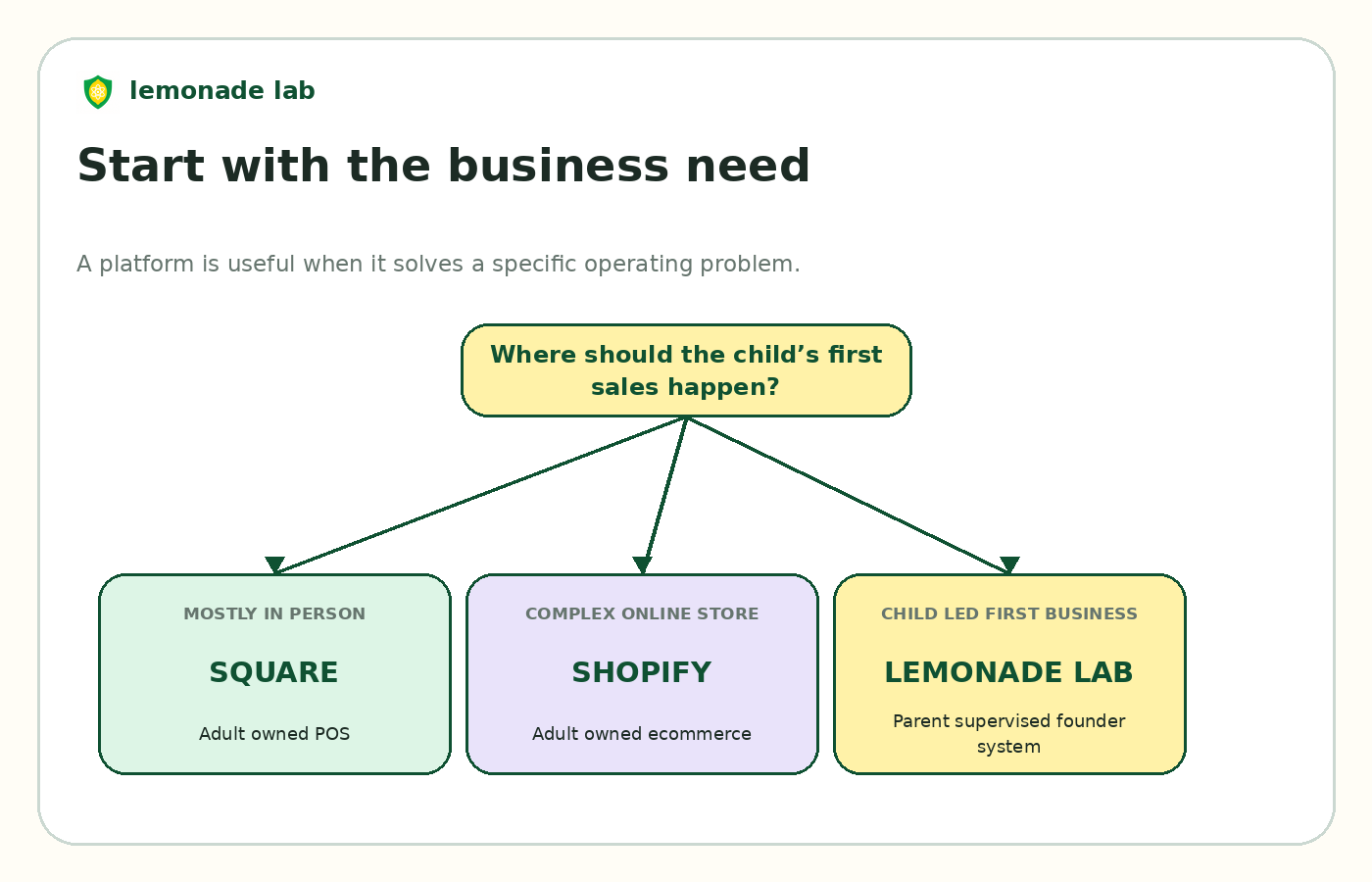
There is a third question worth asking: does the child need adult commerce software, or a place built for a child to run the first business?
Square and Shopify solve different problems
Square began with point of sale. Its strength is helping a merchant take payment in person, track sales, and operate a local retail or service business. It also offers websites, invoices, appointments, inventory, and related tools.
Shopify began with ecommerce. Its strength is helping a merchant build a branded online store, manage products and inventory, sell across channels, ship orders, run marketing, and add capabilities through apps. Shopify also offers point of sale.
The overlap is real, but the center of gravity is different:
- Square: payment first, especially in person
- Shopify: store first, especially online
For a child’s business, both systems require an adult account owner. Square requires account holders to be at least 18. Shopify requires the person opening the account to be at least 18 or the local age of majority.
That means the comparison is not “Which account should my child open?” It is “Which adult merchant system should I open for the child’s project?”
Quick comparison
| Factor | Square | Shopify |
|---|---|---|
| Best starting use | Stands, markets, local services, in person payments | Branded online store and larger ecommerce operation |
| Account owner | Adult | Adult |
| Basic fixed cost | No monthly fee for Square Free | Monthly subscription on standard plans |
| U.S. in person fee | 2.6% + US$0.15 on Square Free | From 2.6% + US$0.10 on Shopify Basic |
| U.S. online fee | 3.3% + US$0.30 on Square Free | From 2.9% + US$0.30 on Shopify Basic |
| Canada in person credit fee | 2.5% | From 2.6% on Shopify Basic |
| Canada online fee | 2.8% + C$0.30 | From 2.8% + C$0.30 on Shopify Basic |
| Website depth | Useful, especially with Square’s broader ecosystem | Stronger ecommerce customization and app ecosystem |
| Hardware | Tap to Pay and optional readers, terminals, registers | Shopify POS and optional hardware |
| Child specific oversight | No | No |
| Child motivation and progression | No | No |
Rates shown are public standard rates checked August 17, 2026. Actual rates can vary by plan, region, payment method, and account.
Cost comparison for a small kid business
Imagine a child sells twenty US$10 items in one month, for US$200 in revenue.
Square, all sales in person
At 2.6% plus US$0.15 per sale:
- Percentage fees: US$5.20
- Fixed fees: US$3.00
- Approximate processing total: US$8.20
- Monthly software fee on Square Free: US$0
Shopify Basic, all sales online
Using the current U.S. annual Basic price and standard online card rate:
- Monthly plan equivalent: US$29
- Percentage fees: US$5.80
- Fixed fees: US$6.00
- Approximate monthly total before apps, domain, tax, or shipping tools: US$40.80
This is not a perfect apples to apples comparison because the sale types differ. It shows why the business model matters. Square is inexpensive when a child mainly sells face to face. Shopify’s fixed subscription is easier to justify when the online store generates recurring sales and needs deeper ecommerce tools.
For low priced items, the fixed per transaction amount also matters. Ten separate US$2 sales can cost more to process than one US$20 sale, even when total revenue is the same.
Choose Square when the stand is the business
Square is a practical fit for:
- Lemonade stands
- Craft tables
- School fairs
- Farmers markets
- Neighbourhood services
- Pop up sales
- A parent who already uses Square
It can be ready quickly, and the free plan avoids paying for months when the child is not selling. Tap to Pay can also remove the need for a separate card reader on supported devices.
The tradeoff is that the parent owns the account and usually manages the catalog, settings, deposits, and reports. Square can give the child a professional checkout. It does not automatically give the child a full business building experience.
Choose Shopify when the website is the business
Shopify is a stronger fit when:
- Most sales will happen online
- The business has a stable catalog
- Products need inventory tracking or variants
- Shipping rules are becoming complicated
- The family wants a highly customized brand
- Advertising and multichannel sales are part of the plan
- The parent is prepared to manage an adult ecommerce operation
A teen’s established apparel brand, for example, may outgrow a basic child business platform. Shopify can support collections, discounts, sophisticated fulfillment, analytics, and hundreds of integrations.
The tradeoff is cost and operating weight. For a child testing a first idea, Shopify can make the family build the machinery before proving the demand.
The parent workload nobody puts in the comparison table
Both platforms are adult merchant systems. The parent is responsible for more than verification.
With Square, the parent should expect to manage:
- Banking and deposits
- Refunds and disputes
- Receipt and tax settings
- Hardware and device security
- Customer records
- Any reporting connected to the adult’s taxpayer information
With Shopify, add:
- Subscription and app costs
- Store policies and public contact details
- Shipping rules and fulfillment
- Domain and theme decisions
- More complex product and inventory administration
- Customer service across the online store
The better platform is partly the one the parent is willing to maintain. An abandoned Shopify store is not better than a simple Square checkout that gets used. A perfectly configured Square catalog is not better if the child never sees or understands the business behind it.
Where Lemonade Lab fits
Lemonade Lab starts with the child rather than the merchant stack. The child can create a real shop, add products or services, share it, accept payments, manage orders, and build progress and status. A connected parent sees activity and approves money movement where required.
| Need | Square | Shopify | Lemonade Lab |
|---|---|---|---|
| Accept cards at a busy adult run booth | Best fit | Capable with POS | Capable for simpler young founder use cases |
| Build a complex ecommerce brand | Limited compared with Shopify | Best fit | Not intended to match Shopify’s advanced depth |
| Let the child build the shop | Possible, but inside adult tools | Possible, but inside adult tools | Core product experience |
| Parent control built around a minor | Adult owns everything | Adult owns everything | Parent connection, dashboard, and approval flows |
| Start without fixed software cost | Yes on Square Free | No on standard plans | Yes |
| Build motivation beyond the sale | Not a core feature | Not a core feature | Quests, levels, collaboration, and founder identity |
| Sell local services | Strong payment tools | Possible | Built for products and services |
Current Lemonade Lab pricing is free to start. The first $100 earned in a month has no transaction fee, after which a 3.5% shop running cost applies. Cashout processing costs may apply and are shown before parent approval.
Lemonade Lab will not replace a mature Shopify operation or a high volume Square POS setup. It is the better first system when the child should operate the business and the parent should supervise rather than become the founder.
Three realistic scenarios
1. Nine year old selling lemonade twice this summer
Best starting choice: Lemonade Lab or a parent owned Square setup.
Use Square when the only issue is accepting taps at the stand. Use Lemonade Lab when the child also wants a shop, product page, progress, and a record of the business. Shopify is difficult to justify for two selling days.
2. Thirteen year old offering dog walking every week
Best starting choice: Lemonade Lab, possibly with Square if the parent already uses it.
The business needs service descriptions, customer requests, scheduling, safe communication, payments, and parent oversight. Shopify can handle services with apps, but it is not the most natural first setup.
3. Seventeen year old shipping a growing clothing line
Best starting choice: Shopify, with the adult as account owner until the teen is eligible.
The business may need variants, inventory, shipping rates, discount codes, analytics, and a broader commerce ecosystem. Lemonade Lab can still support founder identity and community, but Shopify may be the operational engine.
Do not open both just because both are popular
Running Square and Shopify together can work, but it introduces synchronization questions:
- Where is inventory updated?
- Which product catalog is correct?
- Where are refunds recorded?
- Which sales report is used for taxes?
- Are online and in person customers receiving consistent prices?
- Who controls the passwords and customer data?
For an adult retailer, integration can solve much of this. For a child’s first business, it can create needless administration. Start with one clear operating system and add a second only when a specific limitation is costing sales or time.
Frequently asked questions
Is Square cheaper than Shopify?
For occasional in person sales, Square Free is usually cheaper because it has no monthly software charge and only collects payment processing fees. Shopify may be better value for an active online store that needs its ecommerce features.
Can a child own either account?
No. Square requires the account holder to be 18. Shopify requires the person opening the account to be at least 18 or the local age of majority. A parent must own the account and accept the responsibilities.
Does Shopify include in person payments?
Yes. Shopify offers point of sale tools and hardware. Its strongest reason to choose it is usually the connection between a robust online store and in person inventory, not simply the ability to tap a card.
Can Square build a website?
Yes. Square offers online selling tools. They may be enough for a simple catalog, ordering page, or local business. Shopify generally provides more ecommerce customization and expansion options.
Which one is safer for a child?
Both provide adult business security features, but neither is a child specific environment. A parent should control the account and supervise access. Lemonade Lab’s parent and safety system is designed around minors.
The decision
Choose Square for a parent owned, in person payment setup. Choose Shopify for a parent owned, full ecommerce operation. Choose Lemonade Lab when the child’s ownership, motivation, and progression are part of the product requirement.
The first platform does not need to be the last platform. It needs to be light enough for the business to begin and clear enough for the child to remain the founder.
Platform rules and prices were checked on August 17, 2026. Fees and policies can change. This article is general information, not legal, tax, or accounting advice.